Fractional director of email marketing vs fractional manager: which one your team needs

Two job titles keep turning up in our enquiry form: fractional director of email marketing, and fractional email marketing manager. The people asking usually want the same thing: someone senior, part-time, who makes the email programme work. They pick the title that sounds right and hope the market sorts out the rest.
The market does not. The two roles are priced in the same range, described in the same words, and do different jobs. A director decides. A manager builds. Hire the wrong one and you either pay for a plan nobody can execute, or for execution with nobody deciding what to execute. This post draws the line, puts the published rates side by side, and gives you six questions to settle it before the first call.
TL;DR: A fractional director of email marketing sets the strategy, the priority metric and the calendar, and needs someone else to build. A fractional email marketing manager owns the Customer.io workspace and ships: events, segments, automations, emails, tests and the monthly report. With fewer than one in-house marketer who can build in Customer.io, hire the manager. With a team that already builds, hire the director. Most SMBs asking for a director need the manager. Price will not decide it. Practicus puts a UK fractional CMO retainer at £3,000 to £10,000 a month; our own fractional retainers run from £2,000/$2,900 to £12,000/$17,500 a month depending on requirements. A full-time UK CRM manager's median salary of £64,500 (IT Jobs Watch) is about £5,375 a month on our arithmetic, inside both ranges.
Two titles, two jobs
Start with how the people who sell these roles describe them.
Practicus, a UK interim and fractional recruiter, describes a fractional CMO as someone who will "set the marketing strategy, priorities and direction that your existing team then delivers against". It is explicit about what the role excludes: "managing your email platform or handling day-to-day execution" (Practicus). A fractional director of email marketing is that role, narrowed to one channel. They own the plan. Somebody else owns the workspace.
MarketerHire, a US marketplace for fractional marketers, draws the same line from the price end. Below $3,000 a month, it says, you are usually getting a consultant: "advisory only, no hands-on execution". Strategy-only work fits in 5 to 10 hours a week; strategy plus execution oversight needs 15 to 20 (MarketerHire). Note the word oversight. Even at the top of that range, the director oversees execution rather than doing it.
A fractional email marketing manager is the other job. Our service page describes it as "a senior-level specialist who embeds into your team on a part-time or retained basis" (fractional email marketing manager). The manager logs into Customer.io. They define the events, build the segments, build the automations, set the goals, run the tests and write the report. On a small team they also set the plan, because nobody else will. That is why most SMBs asking for a director end up needing the manager: the director's plan has no hands to land on.
We covered the data half of the manager's job in our post on the fractional database marketing manager: the same role under another name. This post is about the line above it.
Role by role
Here is the comparison we use on a first call. The days-a-month figures are our bands: the director's from Practicus's 1 to 3 days a week, the manager's from our client work. The sources for the costs are in the next section.
| Fractional director of email marketing | Fractional email marketing manager | |
|---|---|---|
| What they own | The lifecycle strategy, the one priority metric, the quarterly plan and the send calendar. Reviews what the team builds. Reports to the founder or the board. | The Customer.io workspace: event schema, segments, automations with goals and exits, email copy and build, tests, the monthly report. |
| What they need from you | People who can build: an in-house marketer who knows Customer.io, a designer, a developer, or an agency. Decision rights and a budget. | Workspace access, a named developer for tracking changes, copy sign-off within a day or two, and your numbers. |
| Days a month | 4 to 12, weighted to planning weeks and reviews. | 4 to 8, spread evenly, because the work is building and checking what went live. |
| What they cost | £3,000 to £10,000 a month at UK fractional CMO rates; $3,000 to $15,000 in the US. | £2,000/$2,900 to £12,000/$17,500 a month with us, depending on requirements. |
| Measured on | The priority metric moving quarter on quarter, and the team shipping the plan on time. | What went live each month, and each automation's goal conversion against its baseline. |
| Fails when | Nobody on your side can build what they plan. The plan becomes a document. | Nobody on your side can decide. One day a week becomes one day a month, waiting on approvals. |
Two rows decide most cases. The director needs builders. The manager needs decisions. Ask which of those your team can supply.
What the published rates say
Price is the first thing most people check, and it is the least useful signal here, because the two roles overlap almost completely.
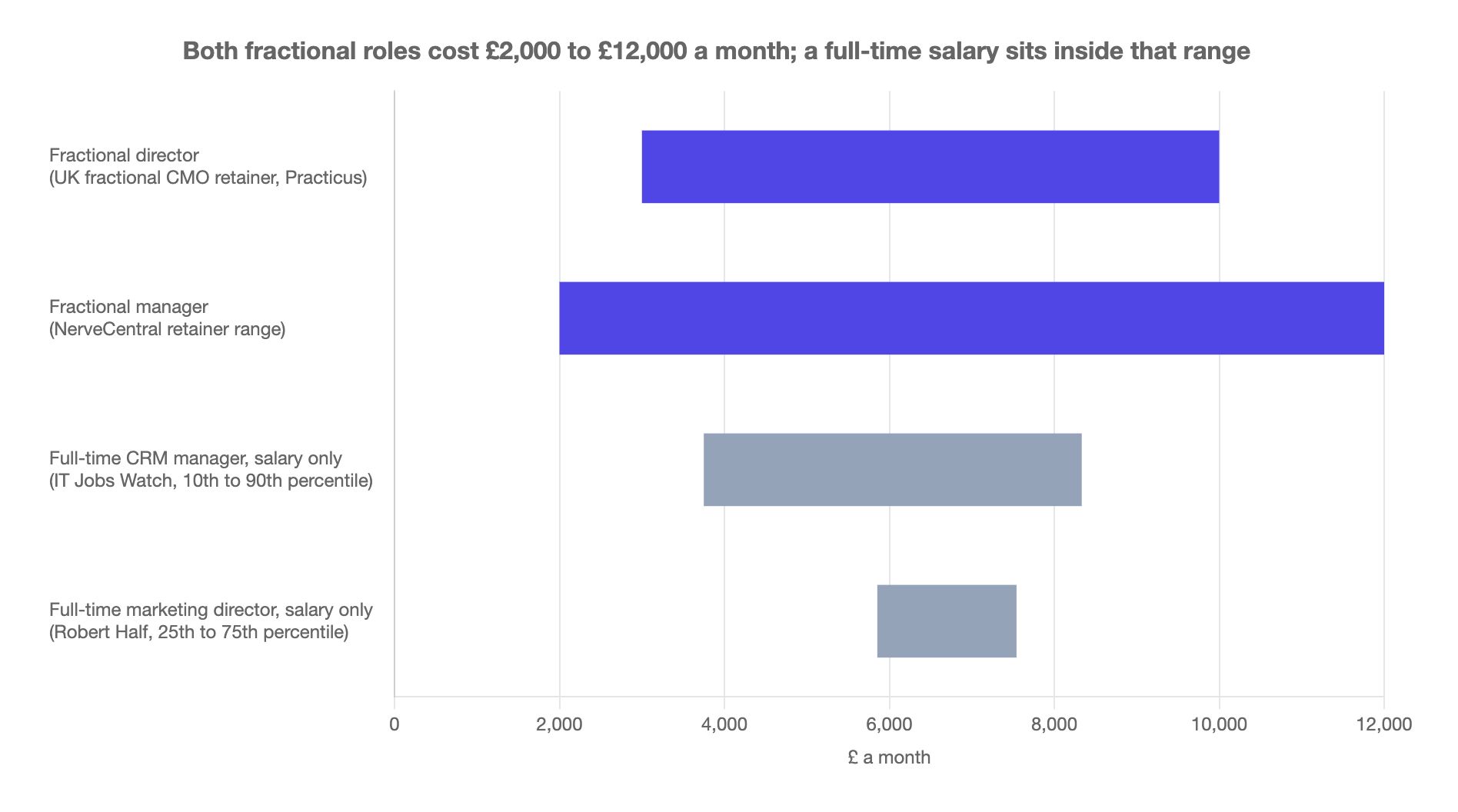
| Option | Published range | £ a month | Source |
|---|---|---|---|
| Fractional director | £3,000 to £10,000 a month, 1 to 3 days a week | £3,000 to £10,000 | Practicus, 20 June 2025 |
| Fractional manager | £2,000/$2,900 to £12,000/$17,500 a month | £2,000 to £12,000 | NerveCentral, our own range |
| Full-time CRM manager | £45,000 to £100,000 a year, 10th to 90th percentile | £3,750 to £8,333 (our arithmetic) | IT Jobs Watch, to 23 October 2026 |
| Full-time marketing director | £70,250 to £90,500 a year, 25th to 75th percentile | £5,854 to £7,542 (our arithmetic) | Robert Half, 2027 UK guide |
The director figures are for a fractional CMO, the nearest role anyone publishes a price for. Practicus gives day rates of £700 to £1,400 and retainers of £3,000 to £10,000 a month (Practicus). In the US, MarketerHire puts retainers at $3,000 to $15,000 a month for 10 to 20 hours a week (MarketerHire). An email-only director should sit at the lower end of each range, because the scope is one channel.
Our manager figures are our own. Few firms publish a fractional manager price, so we quote our own rather than guess at a market rate. Our retainers run from £2,000/$2,900 to £12,000/$17,500 a month depending on requirements (Customer.io agency). Our implementation cost guide explains what moves a quote.
The full-time rows are there for scale. IT Jobs Watch puts the UK median CRM manager salary at £64,500 for the six months to 23 October 2026, from 129 quoted salaries. The 10th percentile is £45,000 and the 90th is £100,000 (IT Jobs Watch). Robert Half's 2027 UK guide puts a marketing director at a median of £80,000 (Robert Half).
On our arithmetic, the £64,500 median is £5,375 a month and the £80,000 median is £6,667, salary only. Employer National Insurance, pension and recruitment come on top; our agency vs freelancer vs in-house guide works through those. The point of the chart is narrower. A full-time salary sits inside both fractional ranges, and the two fractional ranges sit inside each other. Decide on what the role does, not what it costs.
Which one your team needs
Here are the boundaries, by team shape. They are our judgement from client work, not a published standard.
No marketer, the founder runs email. Hire the manager. A director would hand the founder a plan, and the founder would still be building at 11pm. The manager takes the workspace off the founder's desk and reports back monthly.
One generalist marketer who does not build in Customer.io. Hire the manager. The generalist keeps content, social and the website; the manager owns the workspace and the lifecycle programme, and the two agree a calendar. This is the most common shape we see, and the one where people most often ask for a director by mistake.
One marketer who can build in Customer.io, but nobody setting the plan. This is the first case for a director, at the smallest commitment. One day a week sets the priority metric, writes the quarterly plan, reviews every automation before it goes live and reads the monthly numbers. The builder ships. If the builder is junior, add a day for coaching. If the builder leaves, you need a manager until you replace them.
Two or more builders, or an agency already doing the build. Hire the director. The gap is not hands, it is a plan that ties the hands together. The director sets the metric, the calendar and the review rhythm, and holds the agency to a monthly list of what went live. Our post on what a retainer should ship each month is the checklist a director would use.
A team, and messaging is part of the product. Neither. Hire full time. More on that below.
Two rules cut across all five shapes. If the job is mostly decisions, hire the person who decides; if it is mostly building, hire the person who builds. And when in doubt, start with the manager. A good manager sets a plan good enough for a small programme, and you can add a director if the plan outgrows them. The reverse does not work: a director with nobody to build for is a monthly invoice for a document.
How to tell which you need in one call
Six questions. Answer them honestly before you speak to anyone, including us.
- Who logged into Customer.io last week, and what did they change? If the answer is nobody, or the founder fixing a broken send, you need a manager.
- Who could build a three-email automation with a trigger, a goal and an exit by Friday? Name the person. If you cannot, you need a manager. If you can, go to question 3.
- Who decided what that person builds next, and when? If nobody did, you need a director. If the builder is also deciding well, you may need neither yet.
- What is the one metric the programme is measured on, and what was it last month? If you cannot answer, that is the director's first job; a manager will set one too. Our lifecycle marketing scorecard explains which metric to pick.
- How quickly can you approve a segment definition or a send? Within two days, a manager can work. A week or more, and the manager's days go on waiting. Fix the approval path first, or hire a director who sits in the meetings where approvals happen.
- What is your developer's name, and when did they last change what the app sends? A manager needs tracking changes shipped; a director needs them planned. With no developer at all, ask the manager for a data plan in month one.
If questions 1 and 2 point at nobody, it is the manager. If they point at a real builder and question 3 points at nobody, it is the director. Not sure where your programme stands overall? Our lifecycle marketing maturity assessment places it in ten minutes.
What a manager ships: Kip
The clearest way to show the manager's job is a client where the work was all build.
Kip, Australia's leading pet boarding and daycare provider, came to us with two Customer.io workspaces. Over 200,000 profiles and 80+ live campaigns were scattered across them, with inconsistent event naming and limited segmentation. We merged the two workspaces into one with zero disruption to ongoing customer communications, standardised event and attribute naming, and built new segments on service usage, location, booking frequency and seasonal patterns. Then we developed 12 new targeted campaigns. One win-back campaign from that work went to 1,465 people: 43.1% opened and 7.2% converted.
None of that is strategy. The work was one workspace, clean data, and campaigns for welcome, seasonal services, repeat bookings and cross-selling between locations: building, not deciding. That is the manager's job, and the job most SMBs are describing when they type "fractional director" into a search box.
When neither is right
Both roles have cases where the honest answer is something else.
Hire full time when messaging needs attention every day. If someone has to change a send, answer support or fix a trigger most days, you are buying contract days for a full-time job. MarketerHire's break-even for a fractional CMO is fees above $12,000 to $15,000 a month for six or more months (MarketerHire). Our rule for a manager is three days a week for two quarters in a row. The same applies when your events change with every release, or when messaging is the product: a reminder, a digest, a streak. Make sure a senior marketer can manage the hire. One specialist with nobody above them is the hire that most often goes wrong.
Buy an agency retainer when the gaps are wider than one person. Need strategy, copy, design, data work and Customer.io build at once? One fractional person will spend their days on their weakest gap. A retainer gives you the manager's job plus the skills around it, with cover for holidays and a second pair of eyes on every send. The test is the one we apply to our own: something live every month that you can name, tied to one metric. Our Customer.io agency page explains how we scope one.
Buy a project when the work has an end date. A migration, an audit or one welcome series is not a fractional role of either kind. Fix the scope and the fee, and talk fractional after launch.
Where we fit
We run the manager role for SMB and scale-up clients on Customer.io, as our fractional email marketing manager service. One team owns the schema, the segments, the automations and the report, and the documentation stays with you. When a client already has builders and needs the director instead, we say so on the first call, and we say when the answer is a full-time hire. The proof is on our case studies page.
Not sure which side of the line you are on? Book a call with David and we will run the six questions with you. If you would rather write it down first, send us an enquiry.
Frequently asked questions
What is the difference between a fractional director of email marketing and a fractional email marketing manager?
A fractional director of email marketing sets the strategy, the priority metric and the calendar, and reviews what other people build. A fractional email marketing manager owns the Customer.io workspace and does the building: events, segments, automations, emails, tests and the monthly report. The director needs builders on your side; the manager needs quick decisions.
What does a fractional director of email marketing do?
A fractional director of email marketing decides what the email programme should do and checks that it did it. That means one priority metric with a baseline, a quarterly plan, a send calendar and a review of every automation before it goes live. They read the monthly numbers with the founder or the board. Practicus's description of a fractional CMO applies, narrowed to one channel: the role sets direction that "your existing team then delivers against" (Practicus).
How much does a fractional director of email marketing cost?
A fractional director of email marketing costs about what a fractional CMO costs, usually at the lower end because the scope is one channel. Practicus gives UK day rates of £700 to £1,400 and retainers of £3,000 to £10,000 a month (Practicus). MarketerHire puts US retainers at $3,000 to $15,000 a month for 10 to 20 hours a week (MarketerHire).
How much does a fractional email marketing manager cost?
A fractional email marketing manager with NerveCentral costs from £2,000/$2,900 to £12,000/$17,500 a month, depending on requirements (Customer.io agency). The difference is capacity: emails and automations a month, channels, data work. That range overlaps the published director rates almost completely, so compare the two on what they do, not on price.
Should a small business hire a fractional director or a fractional manager?
A small business with fewer than one in-house marketer who can build in Customer.io should hire the fractional manager. A director would produce a plan that nobody on the team can execute. Hire the director once you have one or more builders shipping work and nobody setting the plan they build to.
Can a fractional director of email marketing work with an agency?
Yes, a fractional director of email marketing works well above an agency, and that is one of the two cases where the director is the right hire. The director sets the metric, the calendar and the review rhythm, and holds the agency to a monthly list of what went live.
When should we replace a fractional role with a full-time hire?
Replace a fractional role with a full-time hire when messaging needs attention every day, when your events change with every release, or when messaging is part of the product. MarketerHire's break-even for a fractional CMO is fees above $12,000 to $15,000 a month for six or more months (MarketerHire). For a manager, our rule is three days a week for two quarters running.
Sources
- Practicus, What Is a Fractional CMO? The Complete UK Guide, 20 June 2025.
- MarketerHire, Fractional CMO Cost: What to Budget in 2026, 15 April 2026.
- IT Jobs Watch, CRM Manager Job Trends, Salaries & Skill Sets, six months to 23 October 2026, read 23 October 2026.
- Robert Half, Marketing Director Salary, 2027 UK Salary Guide, read 23 October 2026.
- NerveCentral, Fractional email marketing manager, read 23 October 2026.
- NerveCentral, Customer.io agency, read 23 October 2026.
- NerveCentral, Kip case study.
Want this working in your Customer.io workspace?
It's what we do all day for SMBs—strategy, automations, deliverability and hands-on execution.
See how we work as a Customer.io agency →