
Customer.io certified partner: what the badge proves, and what to ask for instead

The Trade Marks Registration Act 1875 came into force on 1 January 1876. Bass Brewery, founded in 1777 in Burton upon Trent, was by CITMA's account troubled by rivals imitating its labels. Its red triangle for pale ale became the first UK trade mark registration (CITMA). The usual account is that a Bass employee queued overnight to be first through the door. Both sources hedge it: CITMA says the employee was reportedly queuing, and Wikipedia introduces it with "legend has it".
What changed that morning was proof. Before the Act, proving you owned a mark took time-consuming work. After it, in CITMA's words, "the registration was proof of ownership". The registration is still in force 150 years later.
The red triangle told a drinker who brewed the beer. It never told them whether the pint was any good: the drinking did that. A Customer.io partner badge works the same way, and buyers often read more into it than it says.
TL;DR: The Customer.io Certified Partner badge proves an agency applied, had an onboarding call, signed the partner agreement, logged in to the partner portal and completed Customer.io's onboarding and training. Gold and Platinum are set by referred revenue: $25k ARR of closed-won business for Gold, $50k for Platinum, with referral commission of 10%, 15% and 20%. No tier measures client results. By our own count of the first two pages of the directory on 12 October 2026, 9 of 13 Platinum partners had no client reviews, and every partner with reviews showed 5.0. Hire on three things the badge cannot show. Ask for published client numbers on a page you can read, a sample data model from a past build, and the names of the people who will do your build. NerveCentral is a Certified Partner, so the same test applies to us.
What does the Customer.io certified partner badge require?
Customer.io sets out the tiers in Attachment 1 of its partner agreement. To be a Certified Partner, an agency must have "Completed onboarding and training". It must also meet four onboarding requirements, the same four at every tier:
- Application approval.
- An onboarding call.
- A signed partner agreement.
- A partner portal login.
Before that, a new partner sits in a tier called Partner in Training. Those partners "have access to agency certification content and Channel Account Management support", which tells you what the training is: Customer.io's own course material for agencies.
That content is not public, so you cannot see what it covers or how hard it is to pass. What is public is the Customer.io Academy, which Customer.io calls "a free resource where anybody with a Customer.io account can learn about Customer.io". It runs learning paths on data setup, journeys and deliverability. Your own marketer can take Customer.io's public courses this afternoon.
The agreement also commits each partner to meet a Customer.io representative "once per quarter or other mutually agreed cadence". So the badge is a real filter. It rules out anyone who has not been through Customer.io's partner training, and it means Customer.io has spoken to the agency at least once. The badge is a floor, not a ranking.
Gold and Platinum measure referred revenue, not results
The tiers above Certified are where buyers most often over-read the badge. The agreement defines them by "Closed-won Revenue": the net annual recurring revenue of customers the partner referred to Customer.io. It excludes implementation, professional services and support.
| Tier | Closed-won revenue threshold | Commission on referred revenue | Commission paid for |
|---|---|---|---|
| Certified | $0k ARR | 10% | 12 months |
| Gold | $25k ARR | 15% | 24 months |
| Platinum | $50k ARR | 20% | 24 months |
Source: Customer.io partner agreement, Attachment 1.
Nothing in that table asks how a partner's clients performed. Customer.io decides each partner's tier, and under the agreement a Platinum agency has referred at least $50k ARR of Customer.io subscriptions. That might mean it has built many good programmes. It might equally mean it sells well, or that one large client signed through it. The tier cannot tell you which.
Tier also earns position. The agreement's benefits table gives Platinum partners access to services leads from Customer.io, and Gold partners limited access. The partner directory sorts by "Tier and review count", so a higher tier lists first, whatever its reviews. Our profile shows 11 reviews and sits below Platinum partners with none.
This is normal for vendor partner programmes, and Customer.io's follows the pattern. HubSpot awards tier points per $100 of MRR that partners source, assist or manage (HubSpot). Only its top two tiers add a retention floor: 75% average gross revenue retention for Diamond and 80% for Elite. Klaviyo says its partner course was "previously referred to as the Klaviyo Partner Certificate". It runs 52 minutes and includes a lesson on registering a lead (Klaviyo Academy). Vendors certify partners for selling and for knowing the product. Results are your job to check.
What the directory shows when you count it
We counted the first two pages of Customer.io's partner directory on 12 October 2026: 57 partners in all, 13 Platinum, 6 Gold and 38 Certified. The figures in the chart and table are our own tally from those two pages, not numbers Customer.io publishes.
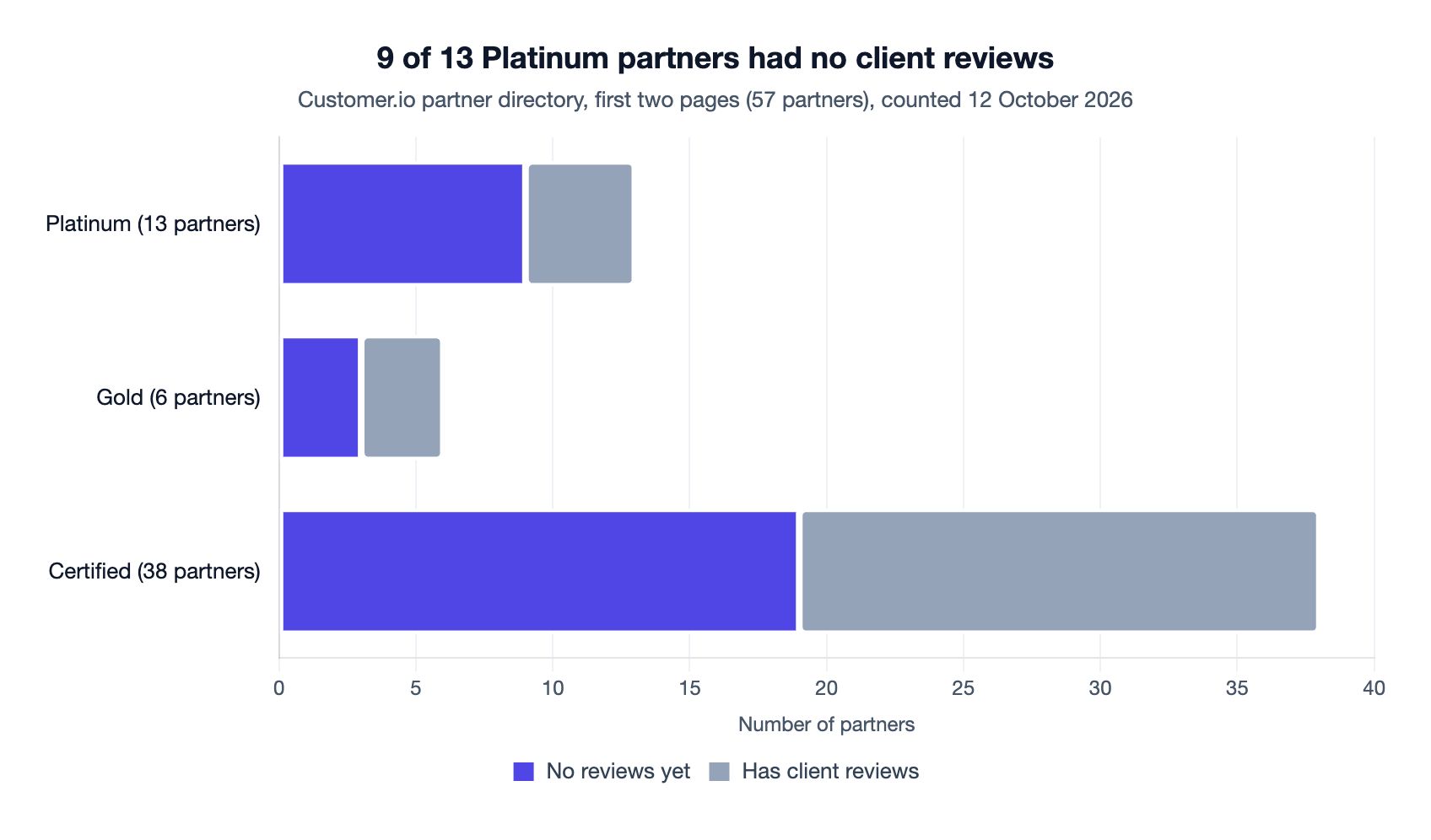
| Tier | Partners | No reviews yet | With client reviews |
|---|---|---|---|
| Platinum | 13 | 9 | 4 |
| Gold | 6 | 3 | 3 |
| Certified | 38 | 19 | 19 |
Two things stand out. First, 9 of the 13 Platinum partners had no client reviews at all. Second, the 26 partners with reviews all showed a perfect 5.0, so the rating separates nobody. A rating where everyone scores the maximum cannot help you choose, and that includes our 11 reviews.
Read the count for what it is. It does not show that Certified partners are better than Platinum ones: half of the 38 Certified partners we counted had no reviews either. Because the list sorts by review count within each tier, the Certified partners further down will have fewer still. It shows that neither signal on the directory card, tier or stars, measures what you are buying.
Test one: published client numbers you can read
The first thing the badge cannot show is what happened to a client's numbers. Ask for case studies on a public page, and judge them on four points:
- A named client. A SaaS company could be anyone. A named client can be checked, and someone there could be asked.
- A before and an after. A conversion rate alone is a boast. Two rates, with the change between them, are a result.
- The metric that matters to you. Open rates are easy to move. Conversions, revenue and churn are harder.
- A page you can link. A number in a sales deck can change between meetings. A number on a public page stays put.
Directory profiles are written by the partners themselves, so a figure on a profile is a claim. A figure on a case study with a named client is evidence.
Here is what we point to. For AIRE Health, a community for dermatologists, we migrated email from an internal system to Customer.io and wrote a data plan. Campaign conversion rate went from 7.0% to 17.8%, a 154% increase. The example campaign on the page shows 4,568 sent, 52.6% opened and 21.1% clicked. The client, the people quoted and the screenshots are all on the page. Every case study we have is at /work, and you should hold us to the same standard as anyone else.
A partner with no public case studies is not necessarily bad. Some clients forbid it. In that case, ask for a reference call with a past client, and ask that client what changed in their numbers.
Test two: a sample data model
The second thing the badge cannot show is how an agency structures data. In Customer.io, the data model decides what every segment, trigger and message can do. Get it wrong and every campaign built on top inherits the problem. Our event schema guide covers why.
Ask to see an anonymised event and attribute plan from a past build. A good one shows:
- Event names in one consistent naming convention, with their properties.
- Which values live on the profile as attributes, and why.
- The identifier strategy: what identifies a person, and how anonymous activity merges.
- Objects or relationships, if the business has accounts, teams or bookings.
- Who sends each event: the app, the warehouse or a third-party tool.
Our AIRE data plan started with the first of these: one standardised naming schema across all existing and new events, built alongside the migration.
Then ask one question about it: why is this an attribute and not an event? A partner who has thought about the data model will answer in a sentence. The answer should sound like our rule on attributes versus events: if a value changes and you will ever ask what it used to be, it needs an event.
Red flags are easy to spot. A partner who wants to start with email templates before discussing data has the order backwards. So does one who prices by send volume: as our implementation cost guide argues, the cost follows the data model and the migration, not the emails.
Test three: who actually does the build
The third thing the badge cannot show is whose hands are in your workspace. The certification belongs to the agency. The person who builds your onboarding campaign may be a senior specialist, a junior hire or a subcontractor.
Ask for names and roles:
- Who will build the automations and write the Liquid?
- Who writes the copy, and who reviews it?
- Who will have access to your workspace, and with which role?
- Is any of the work subcontracted?
- Who do you call when a campaign misfires on a Friday evening?
Workspace access deserves its own question: decide what an outside team may change before it logs in. Our post on the Customer.io execute permission covers how to give an outside team exactly the access it needs.
Team size matters less than honesty about it. A large agency can staff a project well, and a small one can be stretched. What you want is the same answer on the sales call and in the contract. Our first call is with David Crowther, the founder. If you are weighing a team like ours against a freelancer or a hire, our agency vs freelancer vs in-house guide sets out the trade-offs.
Ask whether the partner earns a referral fee
There is a fourth question the badge raises rather than answers. A partner that registers you before you sign can earn a referral fee from Customer.io. Attachment 1 of the agreement sets it at 10% for 12 months at Certified, and 15% or 20% for 24 months at Gold and Platinum. Any partner in the programme can earn one, us included.
That is not a scandal. Customer.io pays it, and HubSpot's tiers rest on sourced revenue in the same way. But it means a partner's advice on which tool to buy is not neutral. The agreement also bars partners from disparaging Customer.io, and asks them to present it in a balanced way against competing services.
So if you have not yet chosen your messaging tool, ask the partner directly whether it will earn a fee if you sign with Customer.io.
A good partner will say yes or no without hesitating, and will tell you when Customer.io is the wrong fit.
When the badge does matter
The badge is not worthless, and there are cases where it should decide things.
- You want a line into Customer.io. The partners page promises partners a connection to Customer.io's partner team for "client questions and support". A partner can take your problem to someone inside Customer.io. The line is stronger at higher tiers. The agreement's benefits table marks a dedicated Channel Account Manager as limited at Certified. Gold and Platinum partners also get a joint Slack channel with Customer.io's client-facing teams.
- You want partner pricing. Customer.io's PartnerStack listing mentions "partner-only pricing" and incentives for clients who come through a partner. If cost matters, ask what a partner can get you before you sign.
- You are screening a long list. The badge removes anyone who has not been through Customer.io's partner training, at no cost to you.
And there are cases where none of this vetting is worth the time. If you need a two-hour fix to one Liquid template, hire whoever can show you they have done it before, badge or not. If your team already has a Customer.io expert and you only need extra hands, a freelancer with Academy courses behind them may be enough. Run the three tests on anyone who will design your data, build your journeys or run your programme for months.
The questions to ask on a first call
| Question | A good answer | A red flag |
|---|---|---|
| Can I see published client results? | Named case studies with before and after figures | Percentages with no client named |
| Can I see a sample data model? | An anonymised event and attribute plan | We start with the templates |
| Why is this field an attribute, not an event? | A one-sentence rule | A shrug, or it doesn't matter |
| Who will do the build? | Names and roles, in writing | Our team |
| Will you earn a referral fee if we sign? | A straight yes or no | Changing the subject |
| What does your tier mean? | Referred revenue, honestly explained | It means we're the best |
If you want to run these questions on us, our Customer.io agency page and our case studies are the place to start. Then send us an enquiry and ask.
Frequently asked questions
What does Customer.io certified partner mean?
A Customer.io Certified Partner is an agency that has completed Customer.io's partner onboarding and training. It has also had its application approved, held an onboarding call, signed the partner agreement and logged in to the partner portal (Attachment 1 of the partner agreement). It does not certify any client result.
How does an agency become a Gold or Platinum Customer.io partner?
An agency becomes Gold or Platinum by referring customers to Customer.io. Gold needs $25k ARR of closed-won referred revenue and Platinum needs $50k ARR, which also raises the commission from 10% to 15% or 20% (the agreement's tier table).
Is a Platinum Customer.io partner better than a certified one?
Not necessarily, because the tier measures referred revenue rather than client outcomes. On the first two pages of the directory, which we counted on 12 October 2026, 9 of 13 Platinum partners had no client reviews (partner directory).
Is there a Customer.io certification exam I can check?
Customer.io does not publish its agency certification content, so there is no public exam to check against. Its Academy is free to anyone with a Customer.io account, so anyone can take Customer.io's product courses.
Do Customer.io partners get paid for referring me?
A partner can earn a referral fee if it registers you, and Customer.io accepts the registration, before you sign. Customer.io pays it as a share of your subscription fees: 10% for 12 months at Certified, or 15% and 20% for 24 months at Gold and Platinum (partner agreement).
How do I check whether a Customer.io agency is any good?
Check three things the badge cannot show: named case studies with before and after figures, an anonymised data model from a past build, and the names of the people who will do your work. Ask for a reference call where case studies are not public.
Can I get cheaper Customer.io pricing through a partner?
Possibly, because Customer.io's PartnerStack listing mentions partner-only pricing and incentives for clients who come through a partner (PartnerStack). The listing gives no figures, so ask the partner what applies to you before you sign.
Sources
- Customer.io, partner agreement, read 12 October 2026.
- Customer.io, Partners, read 12 October 2026.
- Customer.io, Service partner directory, pages one and two, read 12 October 2026.
- Customer.io on PartnerStack, Customer.io partner programme listing, read 12 October 2026.
- Customer.io, Learn Customer.io through our Academy, updated 1 September 2026.
- HubSpot, How do Tiers and Tier Points work?, read 12 October 2026.
- Klaviyo Academy, partner course lesson on tracks and tiers, read 12 October 2026.
- CITMA, The first UK trade mark: Bass & Co, 27 January 2026.
- Wikipedia, Bass Brewery, read 12 October 2026.
- NerveCentral, AIRE Health case study.
Want this working in your Customer.io workspace?
It's what we do all day for SMBs—strategy, automations, deliverability and hands-on execution.
See how we work as a Customer.io agency →