
You Probably Don't Need a VMC for BIMI Yet: An Honest Cost-Benefit for SMBs Sending Under 50,000 Emails a Month
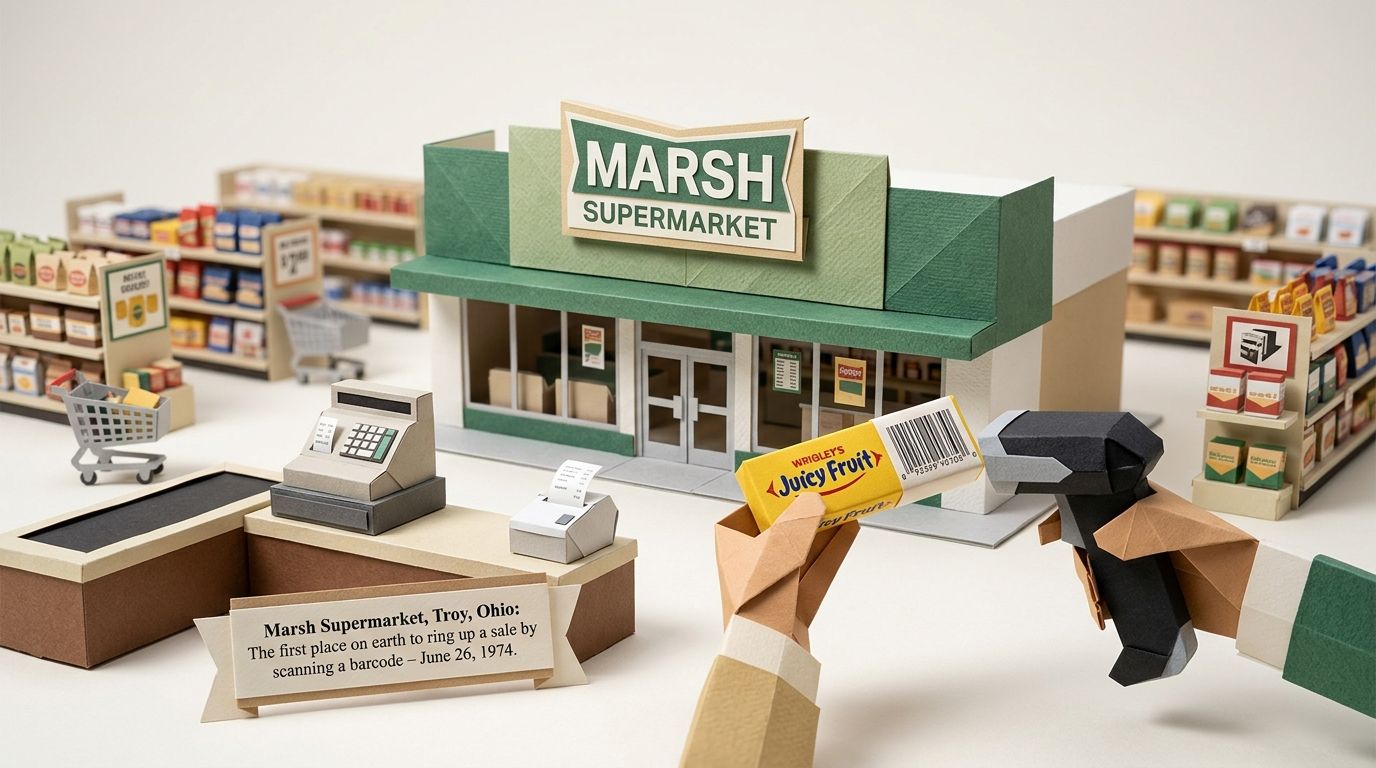
On 26 June 1974 at 8:01 a.m., a Marsh Supermarket in Troy, Ohio became the first place on earth to ring up a sale by scanning a barcode. Clyde Dawson, head of research and development for Marsh, picked a pack of Wrigley's Juicy Fruit chewing gum out of his basket and slid it across the new NCR Electronic System 255 scanner. It beeped. The till showed 67 cents. Modern retail had its first checkout.
What's less remembered is the maths. The scanner system that made it possible cost roughly $4,000 per lane in 1974 dollars—around $24,000 today. The big grocery chains were first because their volume amortised the hardware across enough SKUs and transactions to pay it back. NCR's sales reps then spent years trying to talk corner shops into the same kit. Most of those small shops took longer than promised to break even, and a fair number never did.
BIMI in 2026 is the same trade, dressed up for the inbox. The DNS record is free. The certificate—and the trademark registration, the DMARC enforcement, the SVG tuning, the hosting—isn't. For enterprise brands sending tens of millions of messages a month, the maths still works. For an SMB on Customer.io sending under 50,000 emails a month, the vendor pitch sounds structurally identical to the 1974 NCR rep at the corner shop... and the answer is usually the same.
This post is the honest cost-benefit your certificate authority won't write. We'll break down what a Verified Mark Certificate actually costs you in 2026, deconstruct the 21% open-rate-lift figure that gets quoted everywhere, explain when the new Common Mark Certificate makes sense as a cheaper alternative, and finish with a decision tree that gives you a verdict instead of homework.
TL;DR: If you're an SMB on Customer.io sending under 50,000 emails a month, you probably don't need a VMC yet. The certificate alone runs $1,000–$3,000 a year, but the real year-one cost—trademark filing, DMARC cleanup, SVG production—is closer to £2,500–£5,000 and 6–18 months of waiting. The often-quoted 21% open-rate lift comes from a 2021 survey commissioned by two BIMI vendors, not a measured production test. If your logo isn't trademarked, a Common Mark Certificate (CMC) gets you a Gmail logo without the trademark wait, but not Apple Mail or the blue checkmark. For most SMBs with imperfect DMARC, the same money does more good spent on deliverability foundations first. Revisit BIMI once you're sustaining 50,000+ sends a month, DMARC has held at enforcement for 90 days, or you're in a phishing-exposed vertical.
What is BIMI, and why has it become a marketing line item?
BIMI stands for Brand Indicators for Message Identification. It's the standard that lets your verified logo appear next to your emails in the inbox, alongside a blue verified checkmark in Gmail when you've gone the full distance. The mechanic is straightforward: you publish a TXT record in your DNS pointing to an SVG version of your logo, plus a link to a certificate that proves you own the right to use that logo. Mailbox providers that support BIMI fetch the certificate, validate the logo, and render it.
The reason BIMI shows up on every email vendor's roadmap and every certificate authority's price list is that it's a trust signal that finally gives marketers something to point at. After years of DMARC, SPF and DKIM being treated as plumbing, BIMI is the visible payoff. Your logo. Your blue tick. Your brand standing out in a list of cold pitches and unread newsletters.
The trouble is that the visible payoff is the easy part of the sales pitch. The prerequisites and the maths underneath it are where the honest answer lives.
What you're actually paying for: VMC cost broken down honestly
The headline price of a Verified Mark Certificate (VMC) from DigiCert isn't the real cost. Customer.io's own BIMI guidance puts the certificate fee at "$1,000 to $3,000 per year, depending on the issuing authority and the level of validation required." Call it £800–£2,400 at current rates. That's the line item people quote.
It's also the cheapest part of the bill.
To qualify for a VMC, your logo has to be registered as a trademark with a recognised intellectual property office. The Customer.io guidance is direct about the timing: trademark registration "can take 6-12 months", and the article warns that "if you do not have prerequisites in place, it could take you upwards of a year" to actually go live with BIMI. So if you don't already have a trademark on your logo, your year-one cost includes a USPTO or EUIPO filing fee (around $350 per class at the USPTO), potentially a trademark lawyer, and the better part of a year of waiting before DigiCert can even start validating you.
Then there's DMARC. Customer.io's guidance is unambiguous: to publish BIMI you must "set a DMARC policy to quarantine or reject with the percent option (pct) set to 100." The Validity team's independent analysis of BIMI adoption makes the same point harder: "BIMI is an enhancement built upon a solid email security foundation, specifically DMARC at enforcement (p=quarantine/reject), underpinned by proper SPF/DKIM. It's not the right step if you're still facing basic deliverability issues."
If you're sat at p=none because nobody's done the SPF/DKIM cleanup work across every legitimate sending source—the marketing ESP, transactional sender, support ticketing, payroll provider, the half-forgotten mass mailing tool that finance set up in 2019—then publishing p=quarantine will quarantine your own legitimate mail. Customer.io's own page flags it: "Strict DMARC records, if your business isn't ready for them, can cause issues with your emails being quarantined or rejected." That cleanup is real work. Two to four weeks of monitoring DMARC aggregate reports, fixing alignment, and graduating from p=none to p=quarantine pct=100 is a realistic estimate if you're organised. It's also work the standard now expects of you: DMARC's 2026 rewrite as RFC 9989 treats monitoring mode as a staging post, not a destination.
So the honest year-one cost for an SMB without prerequisites looks more like this:
| Cost item | Estimate |
|---|---|
| VMC certificate | £800–£2,400 |
| USPTO trademark filing (if needed) | £280–£560, plus optional lawyer fees |
| DMARC monitoring tool | £400–£4,000, depending on provider |
| SVG Tiny-PS production and DNS work | Half a developer's day, or a few hundred quid contracted out |
| Calendar time | 6–18 months end-to-end |
That's not £1,500. That's a project budget of £2,500–£5,000 in the first year and the better part of a year of waiting before a single recipient sees the logo. The certificate is the line item; the rest is the bill.
Why Apple's Entrust ban matters for vendor choice
In November 2024, Apple stopped trusting Entrust-issued VMCs created after the 15th. The URIports analysis of the top one million domains found this affected 132 domains, including "prominent brands like Business Insider and BestBuy"—their logos stopped appearing for recipients on Apple Mail's @icloud.com, @mac.com and @me.com domains overnight. Customer.io's own guidance now flags the Entrust limitation and recommends DigiCert as the alternative. The lesson for an SMB about to commit £1,500 a year is that this is a thin market with concentration risk, and that risk gets paid by you when one vendor falls out of a major mailbox provider's trust list.
Update (August 2026): Entrust has since left the certificate business altogether. Entrust Certificate Services stopped issuing new Verified Mark Certificates and S/MIME certificates on 12 May 2025, migrating existing customers to Sectigo, which acquired Entrust's public certificate business in a deal announced that January. DigiCert remains the default recommendation for new VMC purchases; Sectigo (via the migrated Entrust book), GlobalSign and SSL.com are the other issuers in the BIMI Group's current certificate authority directory. The concentration risk this section describes hasn't gone away—it's simply consolidated further.
The 21% open-rate lift, deconstructed
The figure quoted in every BIMI vendor's pitch deck originates in a 2021 survey from Red Sift and Entrust. The press release on Business Wire reports a 21% lift in open rates and a 34% lift in average purchase likelihood when validated logos were shown alongside emails. Vendor pages summarising the same survey have since broken out a 21% US / 39% UK split, though the press release itself reports the headline 21% figure without that geographic breakdown. The numbers have been on every CA's homepage since.
Two things worth front-loading. First, the methodology. The press release describes a survey of 1,026 US and UK adults shown test emails. Participants were baselined against versions of those emails without logos, then shown versions with BIMI logos, and their stated responses on opens, brand recall, purchase intent and confidence in legitimacy were compared. That is a perceptual stated-preference survey on test emails. It is not a measured open-rate delta from a live production send. It tells you what a thousand people said they would do, not what they did.
Second, the sponsorship. The two organisations behind the survey are Red Sift, who sell DMARC and BIMI tooling, and Entrust, who sold VMC certificates (until Apple's ban). The headline is a real survey. It's also a survey commissioned by the two companies who profit when you act on the headline. That doesn't mean the result is fake. It means the methodology and the framing deserve more scrutiny than they typically get when the number gets recycled into a vendor slide.
Now the maths. Take an SMB sending 5,000 emails to a clean engaged list at a 35% open rate. That's 1,750 opens. A 21% relative lift adds 367 opens. Real, but small in absolute terms—and that's the optimistic case, assuming the perceptual lift translates one-to-one to production behaviour, which it usually doesn't. For a brand sending 5 million emails a month, the same percentage adds 367,000 opens and the maths becomes obvious. The percentage is the same; the absolute payoff scales with volume. BIMI's economics are a volume game, which is exactly what the 1974 scanner economics were too.
What the implementation data actually shows
The other half of the picture is how often BIMI goes wrong. Validity's analysis of 13,000 real From-header domains found that "a significant majority (90.85 percent) had no BIMI record, while only 4.57 percent had a valid BIMI record, and 4.58 percent had an invalid BIMI record." Roughly half of attempted BIMI implementations are misconfigured.
The URIports audit of the top one million domains tells the same story at scale. Domains with BIMI DNS records grew 28% year-on-year in 2024–2025, but error-laden records grew 64%—53.6% of BIMI-enabled domains have at least one error. Invalid VMCs grew 43%. Expired certificates grew 57%. The most common single error remains a non-compliant SVG file. BIMI is genuinely tricky to get right, and the rate of botched implementations is rising faster than adoption itself.
If you've got a small team and you're choosing where to spend a week of engineering attention, that's signal.
The CMC alternative since September 2024
On 24 September 2024, Google announced support for Common Mark Certificates in Gmail. The wording on the live page: "Gmail now supports Common Mark Certificates (CMC), a new type of BIMI certificate being issued by Certificate Authorities (CA). CMCs allow a broader range of senders to utilize BIMI, who might not have the registered trademark required for a Verified Mark Certificate (VMC). With a CMC, the sender's brand avatar will be displayed without the Gmail verified checkmark that's displayed for VMCs."
What you get with a CMC: a logo in Gmail, without the trademark registration prerequisite. The BIMI Group's announcement describes the rationale: "Trademarks are the highest security bar for validating a logo, but obtaining them can be cumbersome and cost prohibitive for smaller companies. It has been the goal of the BIMI group to ensure accessibility for brands of all sizes, and CMC is the first major step in that direction since VMC."
What you don't get with a CMC: the blue verified checkmark in Gmail, support in Apple Mail, or the trademark-backed protection that makes VMC a meaningful anti-phishing signal. CMC requires you to demonstrate over a year of verifiable use of the logo, but it skips the trademark filing. Pricing typically sits below VMC but the savings are modest. The bigger saving is the 6–12 months of trademark-application wait.
| VMC | CMC | |
|---|---|---|
| Trademark required | Yes, registered with an IP office | No—a year or more of verifiable logo use instead |
| Gmail blue checkmark | Yes | No |
| Apple Mail support | Yes | No |
| Typical annual cost | $1,000–$3,000 | Usually lower, but the saving is modest |
| Biggest saving vs the other | The trust signal itself | Skips the 6–12 month trademark wait |
CMC makes sense for an SMB if your subscriber base is heavily weighted toward Gmail, your logo isn't trademarked and isn't going to be in the next year, and you want logo visibility without the rest of the protection story. It makes less sense if you're going to spend the same money anyway and you have the trademark already, or if your audience skews Apple-heavy. CMC doesn't show up in Apple Mail's BIMI rendering, and Apple Mail still holds the largest market share of email clients in 2026, which means a Gmail-only logo reaches a slice of your list, not all of it.
The "do nothing yet" path, and why it usually beats both
Before you spend £1,500 on a VMC, ask the harder question: what would the same money do if it went into the foundation underneath BIMI instead?
For an SMB on Customer.io sending under 50,000 a month, that money goes a lot further in three other places.
First, deliverability foundations. Get DMARC to p=quarantine pct=100 cleanly, with proper SPF and DKIM alignment across every legitimate sending source. The Validity analysis flagged DMARC enforcement as the universally hard prerequisite—even among domains that have already attempted BIMI, "4.60 percent still incorrectly use p=none." If you're not there yet, that's the work the next pound should buy.
Second, warming and segmentation. A dedicated subdomain warmed properly earns more deliverability lift than a logo ever will, particularly for transactional and lifecycle traffic. Same money, much harder ceiling to hit, much higher payoff at SMB volumes.
Third, complaint rate hygiene. Google's bulk-sender guidance is well known: keep your spam complaint rate below 0.10% and never above 0.30%. The cheapest, fastest way to keep complaints down isn't logos in the inbox—it's proper suppression and frequency capping and a preference centre that gives subscribers somewhere to land other than the spam button. One angry list of 1,000 subscribers who can't find an unsubscribe link does more deliverability damage in a week than BIMI can repair in a year.
There's a fourth angle, and it parallels another piece of vendor maths that looks cheap until you actually run it. The same SMB cost-benefit logic applies to LLM Actions in Customer.io: both are real features with real value at the right volume, both have headline pricing that looks reasonable, and both burn through their economics quickly when the volume isn't there to justify them.
When to revisit the BIMI decision
The point isn't "BIMI is bad." BIMI is fine. The point is sequencing. Revisit the decision when one of these triggers fires:
You've sustained 50,000+ monthly sends for at least a quarter. You've held DMARC at p=quarantine pct=100 (or p=reject) for 90 days clean, with no legitimate mail being quarantined. You operate in a vertical where logo trust is a real conversion lever—financial services, healthcare, regulated industries, anything where phishing impersonation of your domain is a known threat. Or you've had a documented phishing incident on your domain and you need the visible signal in the inbox to rebuild trust with your list.
If two or more of those fire, BIMI starts paying for itself. If none of them are firing yet, the certificate is a line item you don't need this year.
The decision tree
Run yourself through this:
- Are you sending under 50,000 emails a month? If no, your volume is large enough that BIMI economics start working; skip to step 4. If yes, continue.
- Is your DMARC at
p=quarantine pct=100orp=reject, holding clean for 90+ days? If no, that's where the next pound goes. Come back when it's done. If yes, continue. - Is your trademark already registered? If no, CMC is the realistic option—you get logo visibility in Gmail without the 6–12 month trademark wait. Verdict: CMC now, or wait. If yes, continue.
- Is your audience Gmail-weighted or Apple/Yahoo-weighted? If Gmail-weighted and the trademark is in hand, VMC makes sense. If Apple-weighted, the marginal value of BIMI in Gmail alone is lower; consider the spend against the alternatives above.
- Are you in a phishing-exposed vertical (financial, healthcare, fintech)? If yes, the trust signal carries more weight; lean toward VMC. If no, the verdict above stands.
For most SMBs on Customer.io under 50k/month with a clean DMARC story and no trademark in hand, the answer is "not yet." Spend the money on the foundation. Come back in 12 months.
Frequently asked questions
Q: Do I need a VMC for BIMI in 2026?
Not necessarily. Since September 2024, Gmail also accepts a Common Mark Certificate (CMC), which doesn't require a registered trademark. A VMC is still the only path to the blue verified checkmark in Gmail and the only certificate type recognised by Apple Mail. If your audience is Gmail-weighted and you don't have a trademark, CMC is a viable cheaper option. If your audience leans Apple, neither certificate gets you BIMI in Apple Mail without a VMC.
Q: What's the difference between a VMC and a CMC?
A VMC requires your logo to be registered as a trademark with an intellectual property office like the USPTO or EUIPO, and it earns you a blue verified checkmark in Gmail plus logo display in Apple Mail and Yahoo. A CMC needs proof of over a year of verifiable logo use but skips the trademark filing—it gets you a logo in Gmail, but no blue checkmark and no Apple Mail support.
Q: How much does a Verified Mark Certificate actually cost per year?
Customer.io's published figure is $1,000 to $3,000 per year, depending on issuer and validation level. That's the certificate alone. Add USPTO trademark filing fees (around $350 per class) and lawyer time if you don't already have the trademark, plus the engineering work to get DMARC to enforcement and produce a compliant SVG Tiny-PS logo file. A realistic year-one budget for an SMB without prerequisites is £2,500–£5,000.
Q: Is BIMI worth it for a small business?
It depends on volume and what else needs the budget. The often-quoted 21% open-rate lift comes from a vendor-sponsored 2021 survey of 1,000+ adults asked about test emails, not measured production sends. The percentage lift scales with absolute volume: a 21% lift on 5,000 sends adds a few hundred opens; on 5 million sends it adds hundreds of thousands. For SMBs under 50,000 a month with imperfect DMARC, the same money usually earns more invested in deliverability foundations.
Q: Can I get BIMI without a trademark?
Yes, via a Common Mark Certificate. CMC requires you to demonstrate over a year of verifiable use of the logo but doesn't require trademark registration. It works in Gmail (no blue checkmark) but not in Apple Mail. CMC went live in Gmail on 24 September 2024 after BIMI Group and Google standardised the issuance process.
Q: Does BIMI actually increase open rates?
The headline 21% figure comes from a Red Sift and Entrust survey of 1,026 US and UK adults shown test emails. It's a perceptual stated-preference study commissioned by two BIMI vendors, not a measured A/B test of production sends. Real-world lift varies by brand recognition, audience, vertical, and existing trust. The mechanism is plausible—logos help recognition—but the specific 21% claim deserves scrutiny.
Q: How long does it take to get a VMC?
If your logo is already a registered trademark, VMC validation by the Certificate Authority typically takes 2–4 weeks. If your logo isn't yet trademarked, Customer.io's guidance puts trademark registration at 6–12 months and the total time to live BIMI at "upwards of a year" for senders without prerequisites in place.
Q: What's the minimum DMARC policy required for BIMI?
p=quarantine or p=reject, applied to 100% of your mail (pct=100). A policy of p=none is monitoring only and doesn't qualify. Validity's analysis of valid BIMI implementations found 69.24% use p=reject and 26.15% use p=quarantine—most senders go straight to reject once they've cleaned up their authentication.
Q: Does BIMI work in Apple Mail and Outlook?
Apple Mail supports BIMI from iOS 16 and macOS Ventura onwards, but only with a Verified Mark Certificate—CMC is not supported. Yahoo Mail supports BIMI without requiring a certificate (self-asserted BIMI). Outlook does not support BIMI in any of its consumer or business products as of 2026.
Q: Will a CMC show the Gmail blue checkmark?
No. The blue verified checkmark in Gmail is reserved for VMC-authenticated senders only. With a CMC, your logo appears as the avatar but without the checkmark. Google's announcement is explicit about this distinction.
Q: Should I get BIMI before or after fixing deliverability?
After. BIMI is an enhancement built on top of DMARC enforcement, not a substitute for it. Validity puts it plainly: BIMI "is not the right step if you're still facing basic deliverability issues." If your complaint rate isn't comfortably under 0.10%, your DMARC isn't at quarantine or reject, or your bounce rate is high, fix the foundation first. The certificate will not save a sender with reputation problems.
Q: What happens to my BIMI if my certificate expires?
The logo stops displaying. URIports' audit found expired certificates grew 57% year-on-year, which suggests this is a common failure mode. Most CAs sell annual subscriptions and will email renewal reminders, but if the renewal lapses or the certificate URL becomes unreachable, mailbox providers fall back to the default avatar. The recovery is straightforward—renew and republish—but you lose the visual benefit until the new certificate is live.
Q: Is the 21% open-rate lift study credible?
The study exists, the methodology is published, and the sample of 1,026 adults is reasonable for a stated-preference survey. The credibility caveats are that it's a perceptual survey of test emails rather than a measured A/B test of production sends, and it was commissioned by Red Sift (DMARC/BIMI vendor) and Entrust (former VMC issuer). Read it as a directional signal that logos help, not as a precise revenue forecast.
Q: How do I implement BIMI in Customer.io?
Customer.io handles the sending; you handle the BIMI infrastructure at the DNS layer. The workflow: obtain your VMC or CMC from DigiCert, host your SVG Tiny-PS logo file on HTTPS, publish a BIMI TXT record at default._bimi.yourdomain.com pointing to both files, and ensure your DMARC policy is at p=quarantine or p=reject with pct=100 for the sending domain you've set up in Customer.io. The full setup walkthrough is on Customer.io's own learn page.
Q: When should an SMB revisit the BIMI decision?
Four triggers: you've crossed 50,000 monthly sends sustained for a quarter, you've held DMARC at enforcement clean for 90 days, you operate in a phishing-exposed vertical, or you've had a documented impersonation incident. If two or more fire, the maths starts working. If none are firing yet, the certificate isn't earning its keep yet.
Sources
- Gmail allows more senders to protect their brand using BIMI Common Mark Certificates—Google Workspace Updates Blog, 24 September 2024
- Announcing Common Mark Certificates—BIMI Group (AuthIndicators Working Group), 26 September 2024
- BIMI: Increasing Security and Brand Affinity in the Inbox—Customer.io Learn, Naomi West
- The BIMI Battle: An Analysis of BIMI Adoption and Implementation—Validity, Rafael Viana, 29 April 2025
- BIMI: Updated Analysis of the Top 1 Million Domains—URIports, Freddie Leeman, 16 January 2025
- Red Sift and Entrust Survey on BIMI Logo Display—Business Wire, 20 July 2021
- Email sender guidelines—Google Help
- Smithsonian National Museum of American History: Supermarket Scanner—Smithsonian Institution
- Pack of chewing gum becomes first-ever item scanned with a UPC barcode—HISTORY.com
- Entrust: What is BIMI—Entrust
- Sectigo Acquires Entrust Public Certificate Business—Sectigo, 29 January 2025
Want this working in your Customer.io workspace?
It's what we do all day for SMBs—strategy, automations, deliverability and hands-on execution.
See how we work as a Customer.io agency →