
Your Omnichannel Strategy Is Quietly Missing 70% of Your Non-US Audience: Why Native WhatsApp and LINE in Customer.io Change The Math
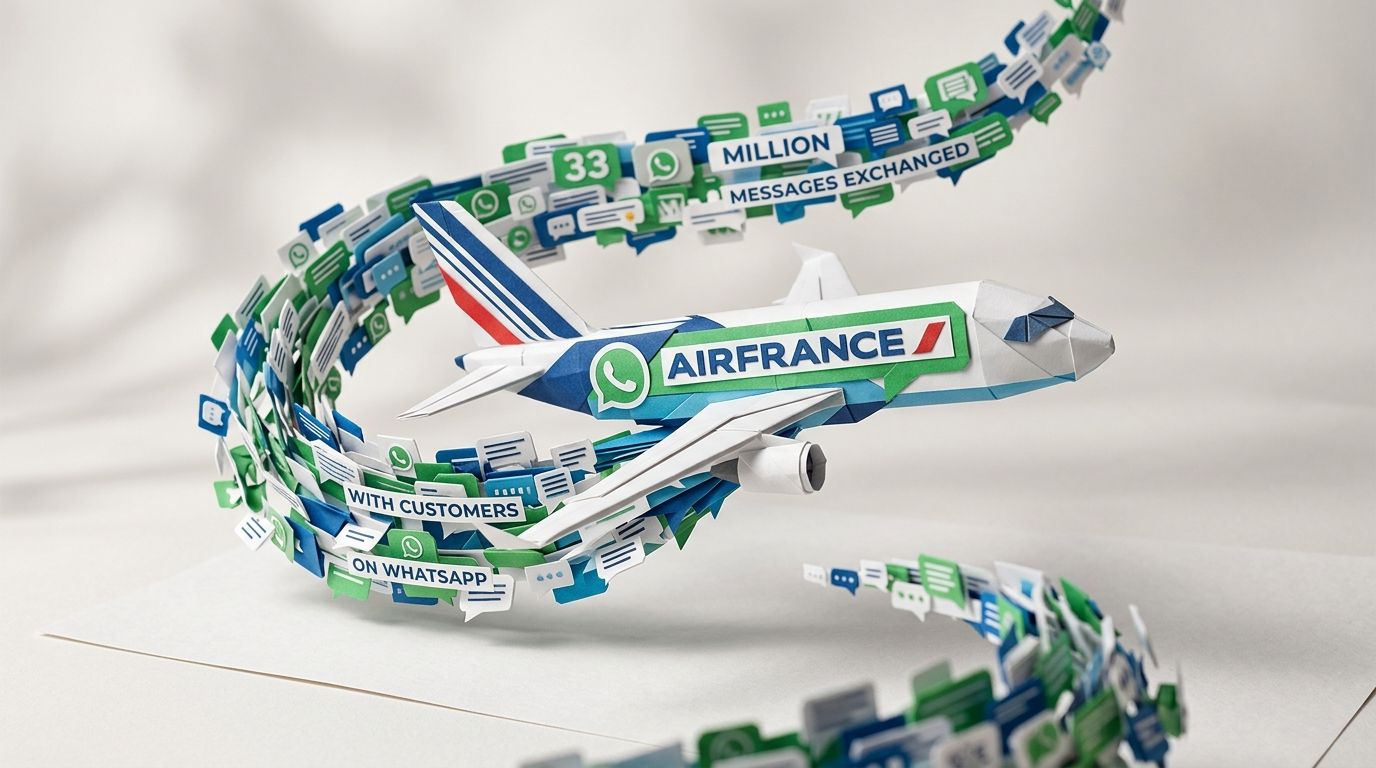
In the twelve months between April 2024 and April 2025, Air France exchanged more than 33 million messages with its customers on WhatsApp. Ten million of those were utility messages (boarding passes, gate changes, check-in reminders). More than three million were authentication codes. The rest sat across marketing newsletters, customer care, and trip updates. At the end of the year the airline reported a 4.5x higher click-through rate on its WhatsApp "best offers" newsletter compared to email, and noted that 85% of all customer-care conversations on social channels took place on WhatsApp rather than Twitter, Messenger, or any other surface (WhatsApp Business success story).
Air France isn't a digital-first start-up. It's a flag-carrier airline founded in 1933, selling, on its own estimate, one ticket every five seconds across its digital platforms. Its customer base spans every European market, North Africa, the Middle East, and West Africa. Most of the parts of the world, in other words, where WhatsApp is the default consumer messenger.
The pattern Air France measured is the pattern every internationally-expanding scale-up will see once they stop assuming SMS or email is the right channel by default. WhatsApp outperforms email for transactional and promotional content in any market where the audience already lives in WhatsApp.
Until February 2026, running WhatsApp at this scale from inside Customer.io meant relaying it through Twilio. Most teams either accepted the middleware tax (separate billing, fragmented analytics, sender confusion in the delivery log) or didn't bother. That changed on 17 February 2026 with Customer.io's native WhatsApp release, and again on 9 March 2026 with native LINE.
This post is the argument for why that combination shifts the omnichannel math for any brand whose audience lives outside the United States. It covers the three campaign archetypes worth building first, the compliance reality most "WhatsApp is amazing" posts skip, and a market-by-market decision rule that doesn't require you to rebuild your global automation library.
If you've already worked through the canonical complete guide to omnichannel messaging strategy, think of this as the international-expansion follow-up. The first guide covers the four canonical channels (email, SMS, push, in-app). This one covers what changes once two more channels become first-class citizens inside Customer.io.
TL;DR: Customer.io shipped native WhatsApp on 17 February 2026 and native LINE on 9 March 2026, closing the Twilio-relay tax that made both channels a hassle to run. If your audience lives outside the US, this changes the maths: Air France logged a 4.5x higher click-through rate on WhatsApp versus email and moved 85% of its social customer care there. Build post-purchase confirmations, abandoned-checkout recovery, and support handoffs first, routed by country, on top of your existing automations. WhatsApp replaces SMS in most of LATAM, South Asia, and Iberia; LINE owns Japan, Thailand, and Taiwan; SMS still wins in the US, UK, Australia, and Canada. None of it requires rebuilding your automation library, but it does need a country attribute, Meta-approved templates, and channel-level consent (Customer.io added that on 2 April 2026).
The geography that's costing you
The headline numbers are these. WhatsApp has more than 3 billion active users globally. Customer.io's own product page cites a "98% open rate" on WhatsApp and characterises it as "surpassing email and SMS engagement" (Customer.io). Here's how that reach breaks down across the markets this post cares about most:
| Market | WhatsApp reach |
|---|---|
| India | 500 million+ users, the largest single national market (Wapikit) |
| Brazil | 139 million users (Wapikit) |
| Indonesia | 87 million users, roughly 65% national penetration (Wapikit; Infobip) |
| Mexico | around 75% of the population (Infobip) |
| Spain | around 85% of the population (Infobip) |
Pair those numbers with the way SMS deliverability has gone in the same markets, and the SMS-default cadence starts to look like a "skip me" signal.
In India, the Telecom Regulatory Authority of India requires every promotional sender to scrub their list against the National Customer Preference Register before each send (NCPR scrubbing and spam filtering). From 2025, every commercial SMS must carry a category suffix identifying it as promotional, transactional, service, or government. Mis-categorised messages are auto-rejected at the carrier, never reaching the inbox (SMS Compliance and Regulations in India).
Brazil's regulator Anatel has spent the last two years building network-level spam filtering and tightening opt-in rules. Bulk SMS without provable consent is one of the fastest ways to get sender IDs and routes blocked at the carrier (Siratel: bulk SMS to Brazil). Anatel publicly declared a crackdown on abusive telemarketing in 2024 and is extending the same logic to SMS.
So the unsuspecting picture is: you have a working SMS programme in the US and UK, you expand to Brazil and India, and the same automation now lands in a regulatory environment that's actively filtering it. Meanwhile in those same two markets, WhatsApp is the channel where 80% of small businesses already communicate with customers (Wapikit WhatsApp Business Statistics 2025). The asymmetry is hard to ignore once you've seen it.
LINE's quieter dominance in APAC
LINE doesn't get the airtime WhatsApp does in English-language marketing content, but its dominance in its core markets is tighter. According to LY Corporation (LINE's parent), LINE had 98 million monthly active users in Japan as of late March 2025, covering roughly 80% of the country's population of around 123.7 million (LY Corporation Media Guide, July 2025).
Customer.io's release-notes page for LINE puts it like this: "LINE is the dominant messaging app in key Asian markets, with over 90 million monthly active users in Japan alone and market penetration of 70-95% in its core regions." Customer.io adds that in those markets, LINE "isn't just another channel", it's "how people communicate daily" (Customer.io LINE release notes). The core regions in question are Japan, Thailand, Taiwan, and Indonesia.
If your APAC roadmap doesn't include LINE, you don't have an APAC roadmap. You have an English-speaking-APAC roadmap.
What Customer.io's native WhatsApp and LINE actually unlock
Customer.io released native WhatsApp support on 17 February 2026, and native LINE messaging on 9 March 2026. Both are now self-serve, both run on existing plans (Customer.io itself doesn't charge a per-message fee for either channel, more on that in the pricing section), and both produce delivery analytics inside the same workflow analytics surface as email, SMS, and push.
The release-note wording for WhatsApp is direct: "In the past, you had to sign up for third party to send WhatsApp messages through Customer.io, even if you already had a WhatsApp-approved Facebook Business Account. Now you can send WhatsApp messages from Customer.io using your Facebook Business Account without a third-party" (Customer.io). Two months later, both channels were folded into Customer.io's largest-ever release on 8 April 2026, an announcement covering "eight new capabilities" across AI-powered intelligence, outcome-first measurement, a redesigned experience, and expanded channel reach (Customer.io Q2 launch).
The Twilio-relay tax you no longer pay
If you were already running WhatsApp through Customer.io before February 2026, you almost certainly went via Twilio. The relay works, but it costs you clarity in three specific places.
First, in the delivery log. Customer.io's WhatsApp FAQ confirms that when WhatsApp runs through Twilio, the delivery log shows a twilio type rather than a whatsapp type, and "WhatsApp messages sent through Twilio are nearly identical to SMS messages in Customer.io" (Customer.io WhatsApp FAQ). You can only distinguish WhatsApp from SMS sends by parsing the whatsapp: prefix on the to and from fields. The native path, by contrast, ships a clean whatsapp delivery type out of the box.
Second, in the sender configuration. Customer.io itself can't tell, in the Twilio path, which of your Twilio senders are WhatsApp-approved and which are SMS-only. The official FAQ recommends naming conventions as a workaround: "Because Customer.io can't tell the difference [between] WhatsApp and SMS senders, you might want to add 'WhatsApp' or 'SMS' to your sender names in Twilio before you sync sender identities from Twilio to Customer.io" (Customer.io WhatsApp FAQ). The native path knows what it is.
Third, in the troubleshooting experience. Customer.io's get-started page is candid: "Twilio can act as a concierge for your WhatsApp setup, [but] using a third party makes it difficult to understand what parts of the process are handled by Twilio and what parts are handled by Customer.io" (Customer.io WhatsApp Get Started). If a campaign fails to send, you've now got two vendors to triage between.
None of this means rip out your Twilio setup tomorrow if it's working. The native path doesn't force a migration (and if you're using Twilio for SMS in markets where SMS is still the default, you'll keep Twilio anyway). The point is that the architectural reason for running WhatsApp through middleware has gone. Going forward, new WhatsApp builds should default to native unless there's a specific Twilio dependency you can name.
For teams thinking about platform choice more broadly, the honest platform comparison sits next to this discussion. Native WhatsApp closes one of the feature gaps that historically pushed teams towards Braze for international rollouts.
Templates, approval, and what you give up
WhatsApp is not SMS with a tick mark. The two differ in one important way: you don't free-type WhatsApp messages. Every send is a Meta-approved template, populated at send time with Liquid variables.
The docs put it plainly: "Unlike SMS and other channels, you won't write message content directly in Customer.io; WhatsApp messages are based on templates that you create in WhatsApp (or through Twilio), and then populate in Customer.io" (Customer.io WhatsApp Get Started).
That has consequences. You can't tweak copy at 5pm on a Friday before pushing send. Meta's review process for marketing templates runs anywhere from minutes to days. You categorise every template up-front (marketing, utility, authentication, or service) and the categorisation drives both cost and how the message can be sent. Get the categorisation wrong and the template either gets rejected, or worse, gets sent under marketing pricing when you thought it was utility, doubling or tripling the bill.
This is the bit most "WhatsApp open rates are amazing" content skips. The throughput is real, the engagement is real, but the operational discipline is closer to email-with-DKIM than to "SMS but free".
Pricing reality
Customer.io itself doesn't charge per WhatsApp message. The docs state: "Customer.io doesn't charge you for WhatsApp messages. However, both Meta and Twilio (if you use Twilio) charge for WhatsApp usage" (Customer.io WhatsApp FAQ). Meta moved to per-message pricing on 1 July 2025, replacing the older 24-hour-conversation model.
Meta's pricing model has four template categories (Pricing on the WhatsApp Business Platform; cross-referenced by the Customer.io FAQ):
- Marketing templates are charged per delivered message, regardless of whether a customer-service window is open.
- Utility templates (order updates, shipping, account notifications) are free inside an active 24-hour customer-service window, and charged outside it.
- Authentication templates (one-time codes) are billed individually.
- Service messages (free-form replies inside an active service window) are free for the duration of that window.
Rates vary by recipient country. As a rough order of magnitude, marketing templates are an order of magnitude more expensive than utility templates in most countries. India runs cheap, Western Europe runs expensive. Customer.io's FAQ also notes that if you send via Twilio, you'll pay Twilio an additional $0.005 per WhatsApp message on top of Meta's fees.
LINE pricing works differently again. Customer.io itself doesn't charge for LINE sends. Billing is handled on the LINE side through your LINE Official Account, where the pricing tiers are driven by your monthly message volume. The Customer.io LINE Get Started page walks through the channel-access-token setup; the cost figures live on LINE's own Messaging API pricing page.
The net effect is that WhatsApp and LINE both fit into existing Customer.io plans without a plan change, and the per-message cost lives with the upstream provider. For most teams, that means budgeting WhatsApp marketing sends separately from your Customer.io seat cost.
The three campaign archetypes worth building first
If you're starting from a working email and SMS programme, the order of operations matters. Build these three first. Everything else can wait.
1. Post-purchase and shipping (utility template)
This is the strongest ROI play, and it's also the cheapest to operate because most of these messages fit inside the 24-hour free utility window if the customer just placed the order.
Post-purchase confirmation, dispatch notification, delivery-day reminder, and "rate your purchase" follow-up are all utility templates. Map them straight off your existing email and SMS automations, branch by country, and route the LATAM and South Asia branches to WhatsApp. The same applies to APAC routes through LINE.
If you've already worked through how to turn transactional emails into a revenue engine, the WhatsApp version of the playbook is the same idea, with one important constraint: any cross-sell or upsell content that goes alongside the utility update has to fit Meta's template-category rules. Pure utility content is free. Anything that veers into marketing pushes the template into the marketing category and the per-send price goes up.
2. Abandoned-checkout recovery (marketing template)
Abandoned-checkout falls squarely into Meta's marketing template category and gets charged per send. The economics still work because the click-through and conversion delta over email is large enough to absorb the per-message cost.
Air France's published figure is 4.5x click-through versus email for promotional WhatsApp newsletters (WhatsApp Business: Air France) and (per Meta's own disclaimer) "results are self-reported and not identifiably repeatable. Generally expected individual results will differ". Treat 4.5x as a ceiling rather than a guarantee. But even at half that, the message-cost economics work in markets where SMS is being filtered by the carrier and email is going to "promotions".
Architecturally, route by region in the Customer.io workflow. WhatsApp branch for Brazil, India, Mexico, Spain, Indonesia. SMS branch for the US, UK, Australia, and Canada. Same trigger, same business logic, different channel-selection step.
3. High-value support handoffs (service window)
This is the one that keeps coming back when you talk to teams that have run WhatsApp at scale.
The 24-hour service window in WhatsApp works like this: when a customer messages you first, a free-form window opens. For the next 24 hours, you can reply free-form (no template approval, no per-send fee), and so can they. The Customer.io FAQ summarises the rule: "Per WhatsApp requirements, your audience must initiate the session by texting you first. When your audience begins a session, you can send free-form replies for up to 24 hours" (Customer.io WhatsApp FAQ).
This is the architecture behind Air France's 85% customer-care figure. The customer reaches out, the airline replies, and the conversation lives in WhatsApp where the customer was already going to look anyway. It's the right answer for high-value support handoffs (billing questions, account recovery, premium-tier escalations) in any market where the customer is already on WhatsApp.
Note that the native path doesn't yet have the workflow plumbing Twilio offers for detecting inbound messages. If you want to automate service-window handling beyond the basics, the Twilio path is still where the more developed automation lives. The native path is best for outbound triggers and utility/marketing/authentication categories. Service-window automation is the one place the trade-off still favours middleware, at least for now.
Compliance reality (the bit most "WhatsApp is amazing" posts skip)
Three things matter here. Template categorisation, the service window, and consent.
Template categories and the 24-hour service window
The four template categories (marketing, utility, authentication, service) aren't just billing buckets, they're send-rule categories. Meta enforces what content can sit in each category, and getting it wrong leads to template rejection or, worse, throttling of your sender number.
Marketing templates can be sent at any time, with consent, and are paid per send. Utility templates are gated to the relationship between you and the customer (order updates, account changes, appointment reminders) and are free inside an active service window. Authentication templates are one-time codes, always billed, always allowed. Service messages are the free-form replies you can send during the 24-hour service window once a customer messages first.
The 24-hour service window is the one thing most teams under-use. It's the channel-economics cheat code: if the customer initiates the conversation, you can run conversational support entirely free of per-message charge for 24 hours.
Opt-in collection and the Subscription Centre
WhatsApp consent isn't the same as SMS consent. GDPR-strict markets in the EU, plus consent regimes in Brazil (LGPD) and most of LATAM, treat WhatsApp as a distinct channel for purposes of consent capture. A blanket "marketing communications" checkbox on signup doesn't cover you.
Customer.io shipped channel-based subscription preferences on 2 April 2026, which is the consent infrastructure that makes the new channels deployable. The release note describes the change as letting your audience "subscribe or unsubscribe from individual messaging channels" (email, SMS, push, WhatsApp, LINE) "independent of topic preferences". The framing in the same note is that "where topic preferences let people choose what they hear about, channel preferences let them choose how they receive messages" (Customer.io channel preferences).
If you don't already have a working subscription centre, this is the moment to fix that. The Subscription Centre that actually reduces churn walks through the build. Add per-channel preferences as a second axis on top of topic preferences, and you've got the structure that satisfies EU, LATAM, and APAC consent at the same time.
Where Twilio still lives
For brands already running SMS through Twilio, the native WhatsApp path doesn't force a migration. The cleanest pattern most of the teams I work with end up on is:
- Twilio for SMS (because the deliverability, sender pool, and short-code work is already done).
- Customer.io native for WhatsApp (because the Twilio-relay tax is gone).
- Customer.io native for LINE (because there's no alternative worth maintaining).
If your Twilio account is also serving WhatsApp today, leave it in place until the next quarter and migrate the WhatsApp portion to native deliberately. Set sender naming conventions in Twilio first so the SMS-versus-WhatsApp distinction is visible in Customer.io's delivery log during the transition window. Customer.io's FAQ flags this as the recommended workaround (Customer.io WhatsApp FAQ).
The decision rule by market
Here's the rule I'd give a head of CRM at a scale-up running their first international rollout.
WhatsApp replaces SMS entirely in markets where WhatsApp is the default consumer messenger and SMS deliverability is meaningfully degraded by regulator or operator behaviour. That's Brazil, India, Mexico, Spain, Indonesia, Argentina, Italy, Germany, Saudi Arabia, and most of LATAM. The 80% small-business adoption figure in India and Brazil isn't an audience number, it's a normative one: your customer expects to interact with brands on WhatsApp in those markets (Wapikit).
WhatsApp sits alongside SMS in markets where WhatsApp penetration is high but SMS still works for transactional content. Much of the rest of Western Europe, the UAE, South Africa, and the parts of South-East Asia where LINE isn't dominant. Use WhatsApp for marketing and high-value support, SMS for authentication and one-shot transactional alerts.
LINE owns the market in Japan, Thailand, and Taiwan. With LINE penetration in those three markets in the 70-95% range per Customer.io's own data, neither WhatsApp nor SMS is the right primary channel. Run LINE through Customer.io's native integration for everything customer-facing, and treat email as the secondary channel for longer-form or B2B content.
SMS is still the right default in the US, the UK, Australia, Canada, and parts of the Nordics. Operator-level SMS deliverability is workable, the regulatory environment is workable, and WhatsApp penetration is materially lower than in LATAM or South Asia. Don't burn engineering cycles re-routing US SMS to WhatsApp.
The rollout sequence I'd run, given a working Customer.io setup already humming on email and SMS, looks like this. None of it requires rebuilding the global automation library, which is the bit that scares most teams off.
First, add a country attribute to your person profile if you don't already have one. If your data lives in a CDP, this is a five-minute schema change. If it doesn't, this is the bit that takes a week. (The ESP migration guide covers the broader data-model questions if you're rebuilding from scratch.)
Second, add a channel-routing branch to your existing post-purchase, abandoned-checkout, and support-handoff workflows. Keep the trigger and the business logic identical. The branch only changes which channel block fires.
Third, build your first WhatsApp templates: post-purchase confirmation, abandoned-checkout reminder, and one authentication template. Submit them to Meta for approval. Categorise carefully.
Fourth, run two cycles of A/B against the current default in each market and pull frequency and unsubscribe data. WhatsApp fatigue is real and the cross-channel frequency caps and suppression guidance applies here just as much as it does to email and SMS. Don't over-send.
Fifth, promote per-market. Brazil and Mexico first if you've got LATAM volume. India second. APAC LINE rollout is a separate workstream because the template logic is simpler but the connection to LINE Developers Console adds setup time (Customer.io's LINE Get Started documents the exact webhook and channel-access-token steps).
Frequently asked questions
Q: Does Customer.io support WhatsApp natively?
Yes, as of 17 February 2026. Customer.io's native WhatsApp release lets you connect a Facebook Business Account directly without needing Twilio or another third-party WhatsApp Business Solution Provider. The integration covers template-based sends, link tracking, link shortening, and unified analytics inside the same Customer.io workflow surface as email, SMS, and push.
Q: How do I send WhatsApp messages from Customer.io?
You connect your Facebook Business Account from Workspace Settings > WhatsApp, then create Meta-approved templates in your WhatsApp Business Account, then select a template when you compose a WhatsApp send inside a Customer.io campaign. You can't free-type WhatsApp messages, which is the main difference from SMS. Customer.io's WhatsApp Get Started page covers the setup flow.
Q: Does Customer.io support LINE messaging?
Yes, as of 9 March 2026. Native LINE messaging is now part of Customer.io's integration directory. You need a LINE Official Account with the Messaging API enabled, a Messaging API channel in the LINE Developers Console, and your channel access token. The integration supports text and image messages, tracks delivery and engagement, and lets you manage LINE contacts alongside your other channels.
Q: When did Customer.io release native WhatsApp?
17 February 2026. The release was followed on 8 April 2026 by Customer.io's largest-ever product release, which folded native WhatsApp and LINE into a broader announcement covering AI Agent, Goals, and other new capabilities.
Q: When did Customer.io release native LINE?
9 March 2026, three weeks after native WhatsApp. Both channels were then bundled into the 8 April 2026 Q2 launch alongside the rest of the major release.
Q: Do I still need Twilio for WhatsApp if I use Customer.io?
No. The Twilio path is still supported for teams who already have it set up, but new builds don't need it. The native Facebook Business Account integration covers template sends, marketing/utility/authentication/service categories, link tracking, and link shortening. The one area where Twilio still adds capability is inbound message handling for service-window automation, which the native path doesn't yet automate to the same degree.
Q: How much does it cost to send WhatsApp messages from Customer.io?
Customer.io itself doesn't charge per WhatsApp message. Meta charges per message under its tiered pricing model (effective from 1 July 2025), based on the template category, the recipient country, and message volume. Utility messages inside an active 24-hour service window are free. Marketing messages are always billed. If you also route through Twilio, Twilio adds $0.005 per WhatsApp message on top of Meta's fees.
Q: What's the difference between marketing, utility, and authentication WhatsApp templates?
Marketing templates promote products, offers, or content and are always billed per send. Utility templates handle account-related updates like order status, appointment reminders, and shipping notifications, and are free inside an active 24-hour service window. Authentication templates are one-time passwords and verification codes, always billed individually. Service messages are free-form replies inside the 24-hour window once a customer has messaged you first.
Q: What is the WhatsApp 24-hour customer-service window?
It's a free conversational window that opens when a customer messages your WhatsApp Business number. For 24 hours after that inbound message, you can send free-form replies (no template, no per-message charge), and so can the customer. After 24 hours of inactivity, the window closes and you're back to Meta-approved templates. This is the mechanic behind most high-volume WhatsApp customer-care programmes.
Q: How do I get WhatsApp opt-in compliant with GDPR and regional consent law?
Treat WhatsApp consent as separate from email or SMS consent. Use Customer.io's channel-based subscription preferences (released 2 April 2026) to let users opt in to WhatsApp specifically rather than relying on a blanket marketing-comms checkbox. EU GDPR, Brazilian LGPD, and most LATAM consent regimes treat WhatsApp as a distinct channel for consent purposes, so a single-checkbox opt-in won't cover you.
Q: Should I replace SMS with WhatsApp in my Customer.io campaigns?
Only in markets where WhatsApp is the default consumer messenger and SMS deliverability is meaningfully degraded. That's most of LATAM, South Asia, Iberia, Indonesia, and parts of Western Europe. In the US, UK, Australia, and Canada, SMS remains the right default for transactional and authentication content. The right model is per-market routing inside a single Customer.io workflow, not a wholesale channel swap.
Q: Which markets should I keep on SMS instead of WhatsApp?
The US, UK, Australia, Canada, and most Nordic markets. SMS deliverability in those markets is workable, regulatory friction is manageable, and WhatsApp penetration is lower than in LATAM, South Asia, or Iberia. Keep SMS for authentication, two-factor codes, and time-sensitive transactional alerts in English-speaking markets. Use WhatsApp where the audience is already there.
Q: How does Customer.io's Subscription Centre handle WhatsApp opt-out?
Channel-based subscription preferences (released 2 April 2026) let users unsubscribe from individual channels (email, SMS, push, WhatsApp, LINE) without unsubscribing from your programme entirely. A user who's tired of WhatsApp can opt out of WhatsApp while staying on email. The setup runs alongside your existing topic preferences, not as a replacement.
Q: Can I use my existing email automations and just add a WhatsApp channel?
Mostly yes. Keep the trigger and the business logic, add a channel-routing branch keyed off the user's country attribute, and route the relevant markets to a WhatsApp branch instead of (or alongside) the email or SMS step. You'll need to author Meta-approved WhatsApp templates for each touchpoint, but the workflow structure itself doesn't need rebuilding.
Q: What's the best first WhatsApp campaign to build in Customer.io?
Post-purchase confirmation routed by country. It's a utility template, often free inside the 24-hour service window, and your highest-engagement transactional moment. Build it once, A/B against your current email or SMS default in Brazil and Mexico, measure for two send cycles, then promote to your other LATAM and South Asia markets.
Sources
- Native WhatsApp support Customer.io Docs, 17 February 2026
- LINE messaging release notes Customer.io Docs, 9 March 2026
- WhatsApp: Get Started Customer.io Docs, updated 24 March 2026
- WhatsApp: Frequently Asked Questions Customer.io Docs, updated 2 April 2026
- LINE: Get Started Customer.io Docs, updated 9 March 2026
- Channel-based subscription preferences Customer.io Docs, 2 April 2026
- Customer.io's biggest product release: AI Agent, WhatsApp, LINE, and more! Customer.io Docs, 8 April 2026
- WhatsApp marketing product page Customer.io, fetched 19 May 2026
- Air France WhatsApp Business Success Story WhatsApp Business, 2025
- Air France embarks on WhatsApp for a more direct relationship with its customers Air France Corporate, 24 January 2023
- LY Corporation Media Guide LY Corporation, updated 14 July 2025
- Pricing on the WhatsApp Business Platform Meta for Developers, 2025
- WhatsApp Business Statistics 2025 Wapikit, 2025
- WhatsApp statistics 2026: Global usage and market overview Infobip, 2026
- SMS Compliance and Regulations in India (Guide 2026) MDS Media, 2026
- Rules and Regulations for Sending Bulk SMS to Brazil Siratel, 2024
Want this working in your Customer.io workspace?
It's what we do all day for SMBs—strategy, automations, deliverability and hands-on execution.
See how we work as a Customer.io agency →